Thursday, August 27, 2009
Own Horn Tooting
That's when there's suddenly time for blogging, when a new op-ed has been published (this one about the political turnmoil this summer in the U.S. over de Democratic plans to reform health care; in Dutch, as usual). But I'm still planning to write about U.S.-Russian relations (the post I announced weeks ago), and once that bottleneck is behind us, I should write more frequently. I do still have things to say, it's just that I also have lots of things to do.


Wednesday, August 5, 2009
First Encounters with Mt. Ventoux
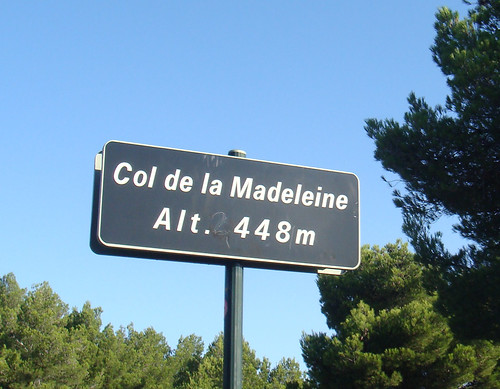
It is a legendary climb, but I had never done it. In cycling literature--certainly in Holland, and most certainly this year--you can read pages and pages about the history of people on this old volcano, often accounts by those for whom getting to the top was some kind of personal quest. We saw lots of them, last week, and quite a few really should not have been there and probably never made it to the top. They were most likely Dutch, Belgian, or French, because cars with license plates of these three countries dominated the roads, cars often with relatives of riders stopping every mile or so to shout encouragement. We, on the other hand, did it by ourselves, two-and-a-half times. We were staying in Bédoin--where the most difficult and infamous ascent begins--had all week, and so we took it one step at a time. On the warm-up day, we rode to Sault--the lavender capital of the world, where the easiest of the three climbs up the hill begins--by way of the quiet and scenic Gorges de la Nesque (north side). That day we climbed as far as the Chalet Reynard, the place where, if you go on, you enter the rocky moonscape for which the Ventoux may be known the best. But we were on a warm-up ride, just getting back on the bike after a few days of traveling and trying to get used to the kind of non-stop climbing required here, so we hung a left and descended toward Bédoin over lots and lots of paint applied just days prior by Tour de France fans. 45 miles was plenty. We did less the next day, about 37, but worked much harder, riding to the third Ventoux town, Malaucene, by way of "the other Col de la Madeleine," and riding to the top from there. This makes it sound easy, but it actually takes work. There is a steep section in the middle--one kilometer marker warned of a 12% grade--which I found to be the hardest climbing of the entire week. I lost my rhythm there. Before that, I had been motoring happily most of the time in either the (39x) 22, 24, or 26. Those steep kilometers in the middle, however, made me unhappy in the 28. The length of the thing made the final two kilometers (steep again) tough also. This being a training ride, we forgot to reset our computers at the start, but I estimate it took me about 1 hour and 35 minutes. Descending the mountain (we completed the loop back to Bédoin) you have to pay attention: lots of cyclists coming up and going down, lots of cars doing the same. You really want to maintain a significant margin for error because there are lots of folks who could make one. On day three it was time for the timed expedition from Bédoin. We warmed up by climbing the little Madeleine, first from Bedoin, then from the Malaucene side. Around 8:30 we were at the line, underneath the plaque for the builder of the road up Mt. Ventoux. The entire way up I tried to keep a balance between pushing and pacing myself. It can be windy the last couple of miles, and you also have to contend with the fact that in the long middle section through the woods, there's really only one switchback where you could take a little breather. The rest is pretty much up, up, and up at a pretty good grade. I had it in the 28 shortly after the steep section started, but was able to turn it over fairly smoothly. It was work, but at the same time I wasn't really breathing very hard. Two kilometers or so before the Chalet Reynard, after only having passed people, I suddenly found someone on my wheel. He must have come up from behind, and he was breathing very hard. It made me wonder if I was trying hard enough. But there was still a good ways to go, and I felt I was going at at least 85%. It was hard to gauge. Up high, the wind wasn't bad at all, and my companion and I picked it up a little when the grade leveled off somewhat after the Chalet. Even though he had been yo-yo-ing off my wheel, with about three K to go he took the lead, and then slowly started pulling away. It wasn't an attack or anything (he kept looking back to see what happend to this dude who had been leading him in such a relaxed way), but for some reason I did not follow. The final section is steeper again, and by then you've been climbing for a while, but I still wasn't breathing hard and didn't really feel I was suffering. And yet, I would not pick it up another notch. The same thing happened when a little later a young rider passed me who was spending about an equal amount of time in and out of the saddle. That would have been the way to make up some ground, and somewhere I must have had it in me. Of course, the top wasn't very far anymore, so the time gained would have been little. That went through my mind also. But the fact remains that rather suddenly I wasn't moving so well any more. I suppose the Ventoux got me a little. So that's how I got to the top, in an even one hour thirty-six minutes, not out of breath, not terribly tired, and somewhat dissatisfied. A faster time is possible. How? Knowing the mountain, having done the climb, should help. Then, getting the body more used to this kind of climbing should also make a difference. Other than that, you just have to train hard, go to the limit on a regular basis, preferably in races. Since moving to Holland, I haven't raced, and I have done very few of the kind of tough training rides I used to get on a weekly basis in Milwaukee. We considered making another attempt on our final day in Bédoin, but then it would have looked as if this actually matters. So instead we chose to do a big, seventy-mile loop all around the mountain, by way of the South side of the Gorges de la Nesque (deserted, rough, and very scenic), Sault, more rough side roads, then around the back of Mt. Ventoux, and back into Malaucene by way of a quiet little up-and-down road through Veaux. Along the way, we agreed that if we had made another attempt that day, it would probably not have resulted in a better time. And it did feel nice, there in the Toulourenc valley behind the mountain, just to be able to let the legs move freely again, without gravity constantly pulling you back.
Sunday, July 5, 2009
Amstel Gold Race Hills
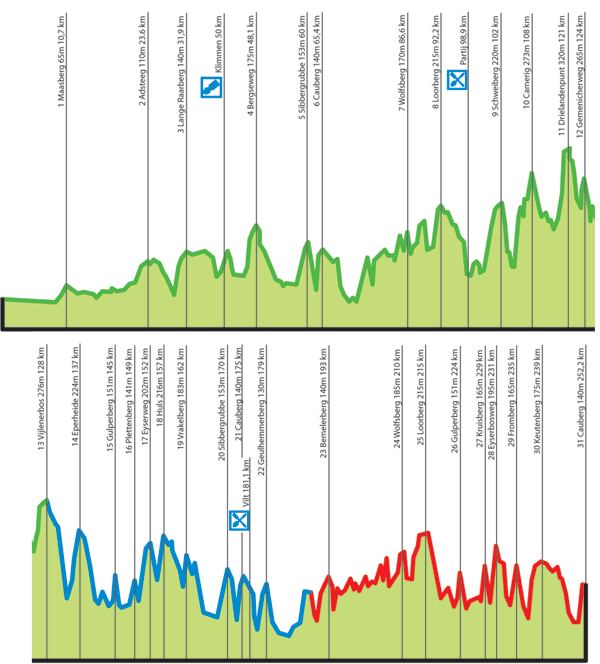
I'll have things to say about Obama, the rest of the West, and Russia later, but first a quick report on a pretty good day on the bike in Zuid-Limburg, the area where the Amstel Gold Race is being held every year. It's a two-hour + drive to get there, but it's worth it (at least on a Sunday, when Dutch traffic is manageable). We rode out of Gulpen on a warm and somewhat humid day. It's up-and-down almost non-stop. You get quality miles, in other words, and 52 today was a very fine total. Leaving Gulpen, we took a little road toward the Belgian town of Teuven. There, we followed the signs to the Gelato Farm--unfortunately not to get gelato (we had barely done five miles, although I do want to check out the home-made stuff they offer there), but to do the "bovenste bos" climb, and nice, gradual, not too difficult 1-2 miler through the woods. The next climb was after Epen (where someone was being serenaded by the local marching band for his or her birthday): the Camerig, a longer one of about two miles, sort of toward Vijlen. I attacked this one happily in the 19. However, as the climbs kept appearing in quick succession, I was happy to revert to the 21 and 23 and eventually looked over at what seemed to be 25s on my companions' bikes with some envy. From Vijlen to the three-country point (those would be the Netherlands, Belgium and Germany), by way of two more uphills. "Vlaai" (local pie) at a pretty nice restaurant there, then on to a couple of hills they ride in the finale of the Amstel Gold Race: Kruisberg (short but steep), Eyserbos (steep, but not so short), and Keutenberg (of legendary steepness). Instead of heading toward Valkenburg and the Cauberg (too much traffic, and we had gotten used to nice little roads without too many cars or even motorcycles), we went to Gulpen and it's "berg" (easier through the woods from the town side that the open back side from the town of Partij). Then to Eys and the Eyserweg, which runs up the same hill as the Eyserbosweg but at a lower grade (and therefore longer). Right at the top toward Simpelveld, from where we tackled the Hulsbergerweg. There, my tongue suddenly started to stick to to roof of my mouth even though I thought I had been drinking well. But I hadn't, because soon after that climb I began to have cramping symptoms which became cramps on the last climb we did: de Dode Man (appropriately named) just before Gulpen. Eleven climbs, and we did our best on all of them, and so back in Gulpen we agreed that we had earned our pancakes. We must have looked like we needed them, because they brought them out at this busy place by the mill within five minutes after we placed our order.
Friday, July 3, 2009
Dekker and Other Alleged Dopers, P.S.
Let's not forget that just about every professional rider caught using banned substances is also--actually first and foremost--a very talented, hard-working athlete. It's nothing new but it bears repeating: people take "doping" for all kinds of reasons, but doping can never turn a mediocre rider into a champion. And the line between riding "clean" and breaking the rules is blurred, gray one--not a sharp black one. This is because racing and training at the top level in this sport (and everyone in the peloton is at this top level) is fundamentally unhealthy. It often makes you sick, and thus you need medical care in order to be able to do your job. So what medical care is permissible, and what crosses "the" line? There will never be unambiguous answers that settle every conceivable issue, because medical science, for one thing, continues to evolve. Yet, the debate--distinguishing between stuff that's mostly in the interest of the rider's health on the one hand, and stuff that's primarily performance-enhancing on the other--is essential. Try to imagine, really imagine, a world in which anything goes. The best we can do is to make distinctions (and devise sactions) that are as honest, fair, and as clear as possible. Exactly where EPO (for a roadie like Dekker, in December) would fall is an interesting question.
Thursday, July 2, 2009
If It's Too Good To Be True ...
... it probably isn't true, not in the world of professional cycling, past or present. Latest example: Dutch prodigy Thomas Dekker, still only 24. Long considered one of the biggest talents of his generation, he won the Tirreno-Adriatico stage race in 2006, and the Tour of Romandie the following year, but last year he left Rabobank under a cloud. Strange things appeared to be happening with his blood values, and in addition the rider had been working independently with a controversial Italian doctor/coach--all things Rabo considered too risky after the Rasmussen affair of 2007. (There's another example of "too good to be true"). Yesterday it was announced that a second test of an out-of-competition urine sample from December 2007 revealed the use of EPO (dynepo). Dekker has responded (today, in the Dutch daily de Telegraaf) by saying that he feels he's being screwed: a retest just before the Tour de France, what's that all about? Interestingly, in this response he doesn't comment on his possible use of EPO (no denial, in other words). Interviewed on Dutch radio this morning, new national coach, former TI-Raleigh and Kwantum team member, and Amstel Gold Race organizer Leo van Vliet made sure to point out that Dekker so far only has been accused (B sample still to come, I suppose), but that if guilty, a two-year ban would be too lenient. According to Van Vliet, to play around with EPO at a time (2007, of all years) when cycling's reputation, indeed its survival, was at stake is terribly irresponsible. The Volkskrant this morning took it one step further, right at the beginning of its report on the matter: Dekker's career is probably over.
Wednesday, July 1, 2009
Obama's Foreign Policy: End of the Honeymoon
I have an op-ed this week in the papers of the GPD (in Dutch, Nederlands Dagblad today) about how Obama's ideas about America's relationship with the outside world ("engagement" and such) are running into the realities of that world. Iran is the best example, but we'll also have to see whether the president will be able to move Israel's government in the direction it wants it to go. In Iraq (withdrawal from towns and cities) the administration is sticking with the agreed-upon game plan, but even though that whole thing was someone else's idea and Obama was opposed to it from the start, if things go wrong it will still be his responsibility (nicely ambiguous term, allowing for the author to mean: his fault, his problem, or both--not advisable for use by students). Not that Obama's new foreign policy emphasis is a failure already. It's more that the rubber (vision) was going to hit the road (real world) at some point, and now things are the way they always are: difficult but not hopeless. Another reason why things aren't hopeless (the word really is inappropriate) is that the goodwill Obama has been able to create around the world through his speeches (Prague, Cairo), his ban on torture, and his planned closing of the Guantanamo Bay detention center is real and is likely to help his diplomacy down the line. Read all about it!
Monday, June 29, 2009
The Cold War and Iran
If history can help us think about contemporary problems, one has to think in general terms, without losing sight of the unique features of both the contemporary case and the historical analogy. So what, if anything, can Cold War history do for us with regard to present-day Iran? In the past, I've thought about East-West detente as a possible example: mutually antagonistic governments (and ideologies) finding ways of limited cooperation because they also have joint interests. That hasn't worked so well for Iran, so far. Obama seems to want to go down this path, but the past couple of weeks have made a detente with the islamic police state an even more distant prospect than it was before. The Wall Street Journal today suggests another Cold War analogy, that of U.S. support for the Solidarity opposition in Poland in the 1980s.
All of which means that there are opportunities for the Obama Administration to exploit, provided it envisions a democratic and peaceful Iran as a strategic American aim. That doesn't mean military confrontation with the mullahs. But it does require taking every opportunity to apply consistent pressure on Iran while exploiting its internal tensions and contradictions.Granted, this so-called money quote is a bit meager, but at the same time it's worth considering what the West can now do to help the opposition keep up the pressure, what we can do to keep the mullahs on the defensive. It's not as if working for change through the regime is promising any quick rewards right now.
Subscribe to:
Posts (Atom)